Why Your Second Season Sailing Often Feels Harder Than Your First
Quick Answer: In your first season you didn’t know enough to notice your mistakes. In your second, you do — so the same performance now registers as failure. This is a well-recognized pattern in skill acquisition: perception improves faster than execution, creating a gap that feels like regression. It typically resolves over the following season as execution catches up.
Last year everything felt like an achievement. This year you’re aware of every bad tack, every moment of oversheeting, every time you misread the wind. Nothing has gotten worse. Your ability to see what’s happening got substantially better.

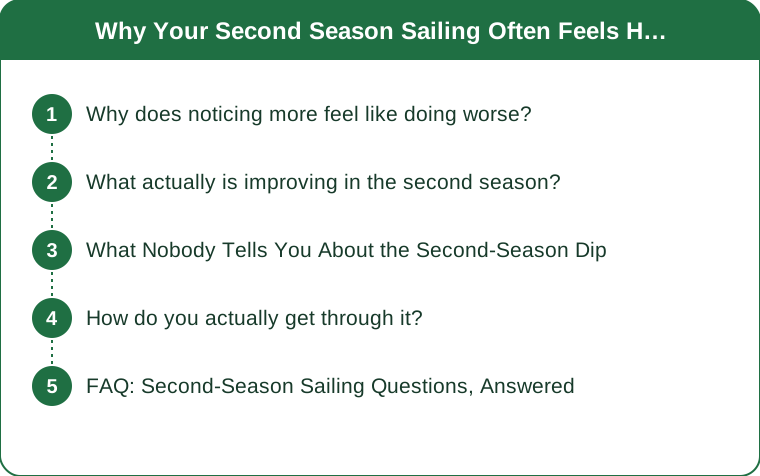
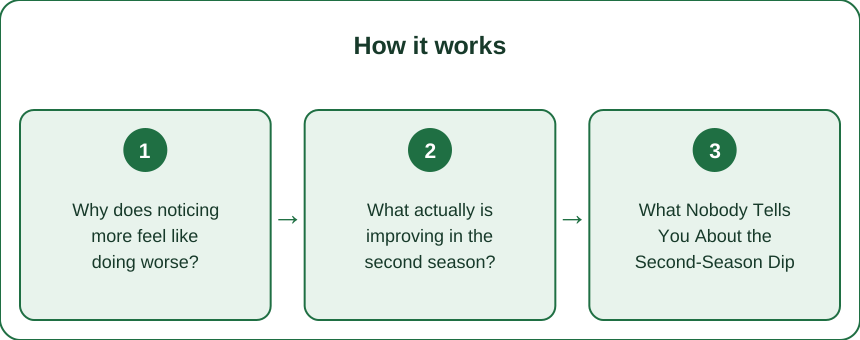
Why does noticing more feel like doing worse?
Because your standard moved and your skill didn’t move as fast.
In a first season, you’re occupied with the basics — where to sit, which line does what, not capsizing. There’s no spare attention for evaluating the quality of a tack, so most tacks register as completed rather than good or bad.
By the second season, the basics are handled well enough to free up attention. That attention immediately goes to evaluation, and evaluation reveals a great deal that was previously invisible: the boat losing speed through the turn, the jib backing for a moment too long, the heading you didn’t hold.
All of that was happening last year. You just couldn’t see it. The subjective experience of getting worse is really the experience of your perception outrunning your execution — and perception nearly always develops first, because it takes less practice than motor skill does.
Why this matters practically
People quit during this phase. Not because they’ve hit a real ceiling, but because the felt trajectory has inverted and nobody warned them it would.
What actually is improving in the second season?
Several things, none of which produce satisfying feedback.
Anticipation. You start seeing wind on the water before it arrives, noticing a gust in the ripple pattern, reading a header coming. This is the highest-value skill in sailing and it’s almost invisible in the moment.
Error recovery. First-season sailors make a mistake and freeze. Second-season sailors make the same mistake and fix it in three seconds. The mistake count doesn’t drop, but the cost of each one collapses — and error count is what you notice.
Load reading. You begin feeling the boat through the tiller and the sheet rather than watching it. Enormously important, entirely unquantifiable.
Decision speed. The gap between recognizing a situation and acting on it shortens considerably.
The measurement problem
None of these produce a number. What produces a number is how many bad tacks did I do, which is a metric that gets worse as your ability to identify a bad tack improves. You’re measuring the wrong thing with the only instrument you have — and that’s the whole trap.

What Nobody Tells You About the Second-Season Dip
It’s steeper for people who progressed fastest initially. Quick first-season learners built more perception in less time, which opens a wider gap between what they can see and what they can do.
It’s worse when you sail with better sailors. Reasonable — a stronger reference point makes your own gap more visible. This is genuinely useful for learning and genuinely demoralizing at the same time.
It’s specific to complex, feedback-poor skills. Sailing gives ambiguous feedback: a bad tack and a good tack in different wind can look identical in outcome. Skills with clean feedback don’t produce this dip nearly as sharply.
Instructors often don’t mention it because from the outside you’re visibly improving. The dip is entirely subjective, so it doesn’t show up in what they’re observing.
Late season concentrates it. By August and September you’ve accumulated a full season of noticing, and the frustration peaks right as sailing conditions are often at their best. That timing is unfortunate and completely normal.
How do you actually get through it?
Four things that help, in order of effectiveness.
Change what you measure. Stop counting errors and start tracking recovery time. How long from noticing the problem to fixing it is a metric that improves with your actual skill instead of your perception. It also happens to be closer to what real seamanship means.
Sail in a wider range of conditions. The dip is worst when you keep sailing the same familiar conditions, where you can see your imperfections in high resolution. Slightly stronger wind, a different point of sail, or an unfamiliar boat resets your attention to survival mode and interrupts the over-evaluation.
Get one specific thing coached rather than sailing more hours. A single session focused on tacking mechanics does more at this stage than ten unstructured outings, because unstructured practice reinforces whatever you’re already doing.
Sail with someone newer than you. The most reliable single intervention. Explaining a tack to a beginner reveals how much you know, and it’s very difficult to maintain the belief that you’ve made no progress while doing it.
How long it lasts
Most sailors describe the dip resolving over the following season, as execution catches up to perception. It doesn’t disappear as much as it stops being noticeable — you enter a rhythm where each improvement in seeing is followed closely enough by an improvement in doing.
FAQ: Second-Season Sailing Questions, Answered
Am I actually getting worse, or does it just feel that way?
Almost certainly the latter. If you’re sailing regularly, measurable performance rarely declines. Ask someone who sailed with you last year — outside observers see the change clearly.
Should I take another course?
At this stage, targeted coaching on one skill beats a general course. You don’t need more curriculum; you need feedback on execution.
Is it better to sail alone or with others during this phase?
Both, deliberately. Solo sailing builds the confidence the dip erodes; sailing with better sailors builds skill. Doing only the second one prolongs the dip.
Does this happen in other sailing skills too?
Yes — it’s common in navigation, docking, and racing tactics, each on their own timeline. You can be in the dip on one skill and past it on another.
When should I worry that it’s a real plateau?
If recovery time isn’t improving over a full season and coaching hasn’t moved it, that’s worth examining. Frustration alone isn’t evidence of a plateau — it’s usually evidence of progress.
TL;DR:
- Perception improves faster than execution, which makes constant progress feel like decline
- Anticipation, error recovery, and load reading all improve invisibly in season two
- Counting errors gets worse as your ability to identify errors improves — change the metric
- Track recovery time, vary your conditions, get one skill coached, and sail with someone newer
- The dip typically resolves over the following season as execution catches up
Feeling worse in your second season is one of the more reliable signs that your first season worked. The frustration is the price of seeing clearly, and it’s temporary.
Keep Reading
This article is for general informational and styling purposes only. Fit, sizing, and product availability may vary.