Why Your Sail Trim Needs Changing Every Time the Boat Changes Speed
Quick Answer: The sail responds to apparent wind - the combination of the true wind and the wind created by the boat’s own motion. As the boat accelerates, apparent wind shifts forward and increases in strength, which means the trim that was correct when you were slow is now too eased. That is why a boat that accelerates nicely then stalls: the sails needed trimming in as the speed built. Trim, accelerate, trim again, and repeat.
You set the sails beautifully, the boat took off, and thirty seconds later it felt sluggish again.
The wind you trimmed for stopped existing the moment you started moving.

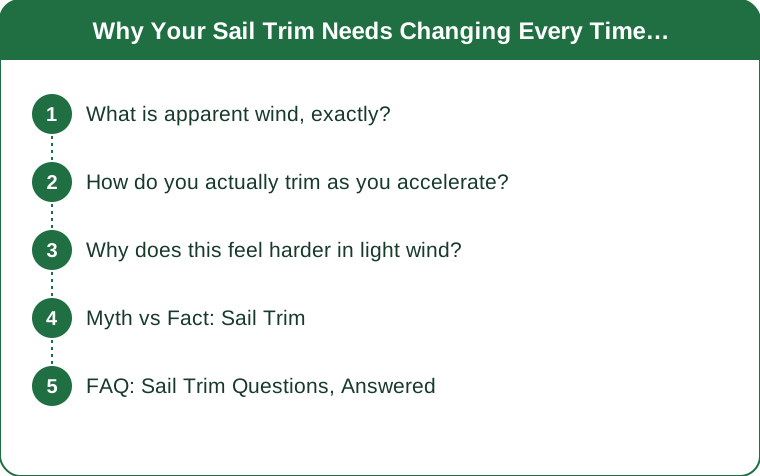
What is apparent wind, exactly?
True wind is what you feel standing still. Apparent wind is what the boat feels while moving, and it is the combination of true wind and the wind generated by the boat’s own motion.
As boat speed increases, apparent wind moves forward - it shifts toward the bow - and generally increases in strength.
Which means the angle the sail is meeting the wind at changes as you accelerate, even though nothing about the true wind changed.
A sail trimmed correctly at 3 knots is trimmed too loose at 5 knots, because the apparent wind has swung forward and the sail is now stalling or luffing depending on point of sail.
This is why the boat feels like it accelerates then plateaus. The sail stopped being efficient the moment its own success changed the wind.
It is also why a gust demands trimming rather than just holding on - a gust increases speed, which shifts apparent wind, which changes the required trim.
How do you actually trim as you accelerate?
Ease out until the sail luffs, then trim in until it stops. This is the fundamental technique and it applies continuously, not once.
Repeat it every thirty seconds or so when conditions are changing, and after every speed change.
Watch the telltales. Both sets streaming aft means the sail is working; the windward set lifting means ease or head down, and the leeward set stalling means trim in or head up.
Trim in as you accelerate, ease as you slow. This one sentence covers most of what changes.
After a tack, the boat is slow, so trim for slow first and then trim in progressively as speed builds. Trimming straight to full-speed settings after a tack is the classic new-sailor error and it stalls the boat.
In lighter wind, ease more and be more patient, since the boat generates less of its own apparent wind.
And in a gust, the immediate response is usually to ease slightly and then trim back in as the boat accelerates and settles.

Why does this feel harder in light wind?
In light air the boat’s own speed makes up a larger proportion of the apparent wind, so small speed changes produce proportionally larger shifts in apparent wind angle.
Which means light wind demands more constant adjustment, not less - the opposite of what most new sailors assume.
Sails need to be eased more and shaped fuller in light air to generate power from less wind.
Crew weight movement matters more, since heeling the boat slightly can help the sails take shape when there is not enough wind to fill them.
Sudden movements kill speed disproportionately in light wind, because rebuilding it takes much longer.
And this is why experienced sailors often say light wind is harder than strong wind - the boat is unforgiving of inattention and the feedback is subtle.
Myth vs Fact: Sail Trim
Myth: you set the sails for the wind conditions and leave them. Fact: apparent wind changes with every change in boat speed, so trim is continuous rather than a setting. Constant small adjustment is what separates a fast boat from a slow one.
Myth: pulling the sail in tighter makes you go faster. Fact: past a certain point, trimming in stalls the sail and the boat slows. The ease-until-it-luffs-then-trim-in method exists precisely because tighter is not reliably better.
Myth: the same trim works on both tacks. Fact: it should be close, but boats are rarely perfectly symmetrical and wind rarely comes from a perfectly steady direction. If one tack feels distinctly better, that is worth investigating rather than ignoring.
Myth: telltales are for advanced sailors. Fact: telltales are the single most useful feedback available to a beginner, and they answer the ease-or-trim question directly without requiring feel you have not developed yet.
Myth: after a tack you should set the same trim you had before. Fact: the boat is slow immediately after a tack, so the apparent wind is different. Trim for the speed you have, then trim in as speed rebuilds.
Myth: heeling more means going faster. Fact: excessive heel usually means over-trimmed sails or too much sail area, and it increases drag while reducing the effective sail area facing the wind. Easing often makes the boat both flatter and faster.
FAQ: Sail Trim Questions, Answered
How often should I adjust the sails?
Continuously in changing conditions - as often as every thirty seconds. Any change in boat speed or wind angle changes the required trim.
What is the simplest trim rule?
Ease out until the sail luffs, then trim in until it stops. Repeat regularly. This one technique covers most situations.
Why does my boat slow down after a tack?
Usually because the sails were trimmed to full-speed settings while the boat was still slow, which stalls them. Trim for the speed you have and trim in as it builds.
What do the telltales tell me?
Both streaming aft means the sail is working well. Windward telltales lifting means ease or bear away; leeward telltales stalling means trim in or head up.
Is light wind really harder?
For most sailors yes. The boat’s own speed forms a larger share of the apparent wind, feedback is subtler, and lost speed takes much longer to rebuild.
Should I trim in during a gust?
Usually ease slightly first as the gust hits, then trim back in as the boat accelerates and the apparent wind moves forward. Holding trim through a gust often causes excess heel rather than speed.
TL;DR:
- Sails respond to apparent wind, which shifts forward and strengthens as the boat accelerates.
- Trim that was correct when slow is too eased once speed builds - so trim, accelerate, trim again.
- Ease until it luffs, then trim in until it stops, and repeat every thirty seconds in changing conditions.
- After a tack, trim for the slow speed you have and build in as speed returns.
- Light wind demands more adjustment, not less, because boat speed forms a larger share of apparent wind.
- Excessive heel usually means over-trimmed, not fast.
The wind you trimmed for stops existing the moment the boat starts moving.
Keep Reading
This article is for general informational and styling purposes only. Fit, sizing, and product availability may vary.