Your Boat Feels Overpowered Before the Wind Actually Picks Up
Quick Answer: The boat feels overpowered when the sail’s angle to the wind becomes wrong, not when wind speed rises. A small increase in boat speed, a slight course change, or a shift in apparent wind can all overload the rig without the true wind changing at all. That is why it feels like the gust arrived early — the loading changed before the wind did.
Everything was fine. Then the tiller got heavy, the boat leaned harder, and you found yourself easing the mainsheet while looking at a water surface that had not changed at all.
The wind did not increase. Something else did.

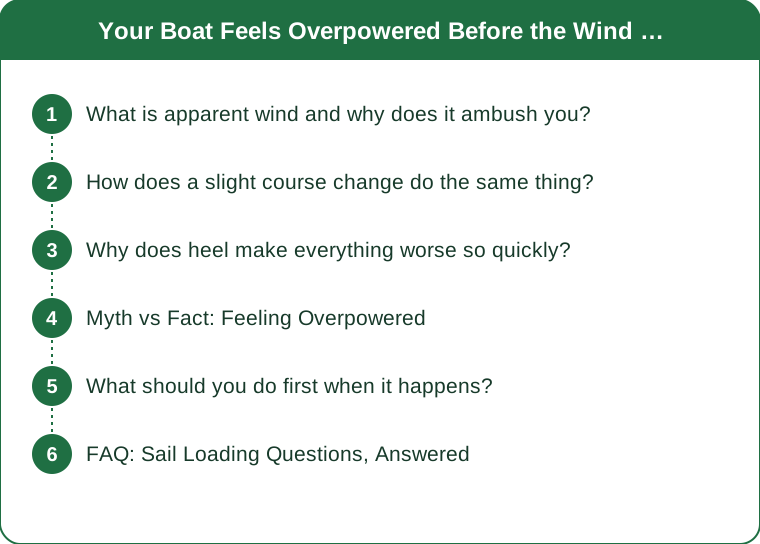
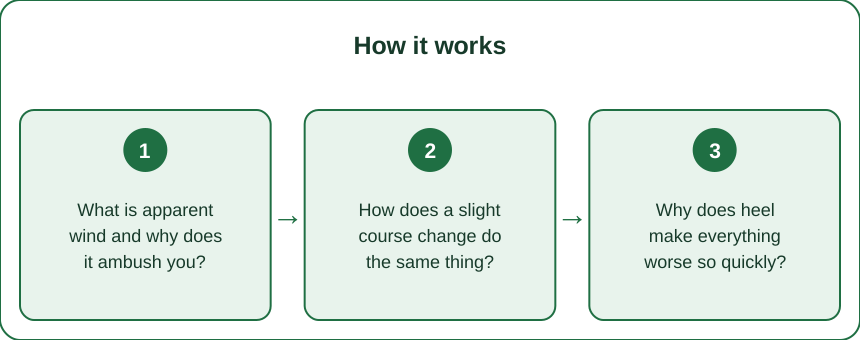
What is apparent wind and why does it ambush you?
Apparent wind is the wind you actually feel — the combination of the true wind and the wind created by your own movement. It is the only wind your sails care about.
Here is the part that catches new sailors: as the boat accelerates, the apparent wind moves forward and increases in strength. So sailing faster makes the wind you feel stronger and more on the nose, even when the true wind is perfectly steady.
That creates a loop. A small puff accelerates the boat. The acceleration increases the apparent wind. The stronger apparent wind loads the sails harder. The boat heels, the rudder loads, and it feels like a much bigger gust than the one that started it.
By the time you notice, you are responding to a self-amplified version of a modest change. This is the single most common reason a boat feels overpowered ahead of anything visible on the water.
How does a slight course change do the same thing?
Because sail loading depends on the angle between the wind and the sail, and that angle changes with every degree of course.
Bearing away just five degrees from close-hauled increases the sail’s effective angle of attack and the driving force with it. You did not trim anything, you did not get more wind, but the rig is now working harder.
This is why the overpowered feeling so often arrives right after a small steering correction — often one you made to avoid a wave or hold a line. You corrected, the loading changed, and the boat responded within a couple of seconds.
The useful habit: when the boat feels heavy, check your heading before you touch the sheets. Very often you have drifted a few degrees and the fix is at the tiller, not the rig. Easing the main to solve a steering problem works, but it costs you speed you did not need to lose.
Why does heel make everything worse so quickly?
Because heel and helm load feed each other.
When a boat heels past roughly 20 degrees, the hull shape becomes asymmetric in the water and the boat tries to turn up into the wind. You counter that with rudder. Rudder held at an angle acts as a brake, so the boat slows. Slowing changes the apparent wind again, and the sail’s angle changes with it.
Meanwhile, heeling reduces the sail’s effective projected area facing the wind but increases the heeling moment relative to the driving force. So past a certain point, more heel gives you less forward drive and more sideways force. You are working harder and going slower simultaneously.
A practical rule for most small keelboats and dinghies: if you are past 20-25 degrees and holding significant weather helm, you are past the efficient range. Flattening the boat — by easing, by hiking, by depowering the top of the sail — usually makes you faster, not slower, which is counterintuitive to almost every new sailor.

Myth vs Fact: Feeling Overpowered
Myth: Overpowered means you need to reef. Fact: sometimes, but far more often it means the trim or the angle is wrong. Reefing when the problem is a five-degree heading error costs you a lot of speed for nothing. Check heading, then trim, then consider reefing.
Myth: Easing the mainsheet is always the first move. Fact: for a brief overload, easing the main is the fast fix. But for sustained overpowering, the first controls are usually the ones that flatten the sail — vang tension, outhaul, halyard — because they reduce power without giving up all your drive.
Myth: A bigger gust always shows on the water first. Fact: gusts do show as dark patches, but apparent-wind loading from your own acceleration does not. That is exactly why the boat can feel loaded up when the water ahead looks unchanged.
Myth: More heel means more speed. Fact: for most boats there is an optimal heel angle, usually modest, and going past it costs speed. The exception is a few light dinghies where a little heel to leeward helps in very light air.
What should you do first when it happens?
A sequence that works, in order and taking about ten seconds total:
- Look at your heading. Are you where you were 30 seconds ago? If you have borne away, come back up a few degrees and the loading often disappears on its own.
- Check the telltales. If the leeward ones are stalling, you are oversheeted, and the fix is easing rather than steering.
- Ease the main a few inches. Not a full dump. Small ease, watch the heel, see if it settles.
- Flatten the sail. Vang on, outhaul on. This reduces power in the top of the sail where the heeling leverage is greatest.
- Move weight. Crew outboard and slightly aft in a breeze. It sounds obvious and it is the most underused control on a small boat.
Only if all of that leaves you still overloaded is it time to reduce sail area. Most of the time you never get to step five.
FAQ: Sail Loading Questions, Answered
Why does my boat feel heavier on a reach than upwind in the same wind?
Because on a reach the sail’s angle of attack is larger and it generates more total force, more of which is sideways than you might expect. Reaching in a breeze often loads a boat harder than beating does, which surprises people who assume upwind is always the hardest point of sail. Ease early and keep the boat flat.
Should I feel weather helm at all?
A little — around 3-5 degrees of rudder angle is generally considered efficient, and it gives you feel and lift from the rudder. Zero helm means you are giving something up. Heavy helm means you are braking. The tiller should feel like it wants to come toward you gently, not like it needs fighting.
How do I get better at anticipating this?
Watch your speed instrument or your wake as much as you watch the water. Since the loop starts with acceleration, your own speed increase is often the earliest signal you will get. Sailors who feel gusts coming are usually reading a combination of water texture, boat speed, and the tug in the tiller rather than any single one.
TL;DR:
- Apparent wind increases as you accelerate, so a small puff amplifies itself into what feels like a big one.
- A five-degree course change alters sail loading as much as a real wind shift.
- Past 20-25 degrees of heel, more lean means less drive and more braking rudder.
- Check heading first, then telltales, then ease, then flatten, then move weight — reefing is last.
- Some weather helm is good; heavy helm is a brake.
The skill that ties it together is learning to treat ‘this feels like a lot’ as a question rather than a conclusion. The wind is one possible answer among four or five, and it is usually not the first one. Sailors who look at the compass before the sheets tend to sail flatter, faster, and with far less drama.
Keep Reading
This article is for general informational and styling purposes only. Fit, sizing, and product availability may vary.