Why Light Wind Is Harder to Sail In Than Strong Wind
Quick Answer: Strong wind gives you enough power that sloppy trim still moves the boat, and the feedback through the tiller is obvious. Light wind gives you almost no power margin, so small errors in sail shape, weight placement, and steering cost a large fraction of the speed you had. It also removes the feedback you have been relying on — the boat goes quiet, and most new sailors do not yet know how to read a quiet boat.
Ask a beginner what conditions worry them and they will say a windy day. Ask an experienced racer which day separates good sailors from mediocre ones and they will say the drifter.
Both are right, for different reasons. Heavy air is more frightening and requires more physical control. Light air requires more precision, and precision is the thing beginners have not built yet.
If you have ever come off a calm-day sail feeling more frustrated than you did on a breezy one, this is why.

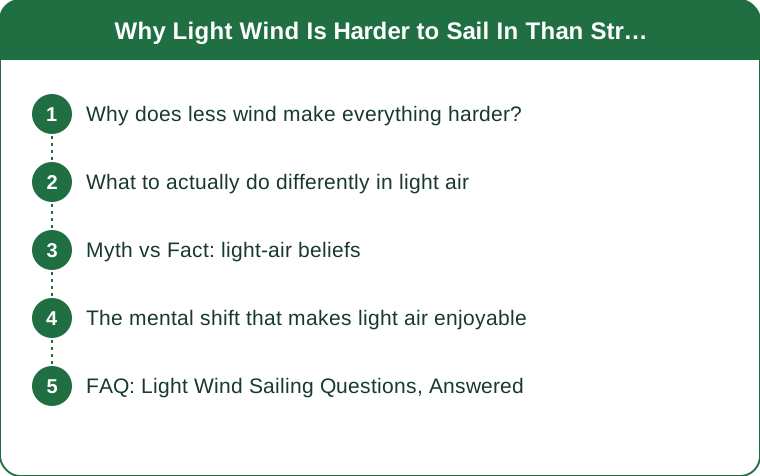
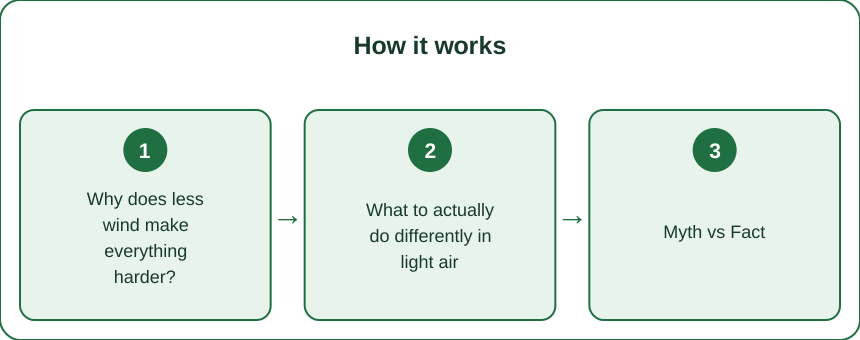
Why does less wind make everything harder?
Because power scales steeply with wind speed, and you are working with what is left.
The force in a sail rises roughly with the square of wind speed. Double the wind and you get about four times the drive. Halve it and you have a quarter of what you had. In 12 knots you can trim badly and still be moving well. In 4 knots the same error is the difference between sailing and sitting.
The second effect is signal loss. In a breeze you can feel the boat load up through the tiller, feel heel, hear water at the hull. Those cues tell you what is happening without needing to think. In light air the helm goes soft, the boat stops heeling, and the water noise disappears. You lose most of your instruments at exactly the moment you need finer control.
Third, everything that slows a boat down matters proportionally more. Weed on the rudder, a person shifting position, a slightly stalled sail — in a breeze these are rounding errors. In light air they are the whole race.
What to actually do differently in light air
Almost every instinct from breezy sailing is wrong here.
Heel the boat to leeward, deliberately. In light wind the sail is not full of enough air to hold its shape, and gravity helps it. A few degrees of leeward heel lets the sail fall into a proper curve and reduces wetted surface area. Sitting flat, which is correct in a breeze, is one of the most common light-air mistakes.
Ease the sails more than feels right. New sailors sheet in when the boat feels slow, because in their head tighter equals more power. In light air, over-sheeting stalls the flow across the sail and stops the boat almost completely. When in doubt, ease until the luff just starts to move, then bring it back a touch.
Move slowly and stay still. Every movement you make disturbs the boat and shakes air out of the sail. Experienced light-air sailors move as little as possible and shift weight gradually.
Steer with tiny inputs. The rudder is a brake, and in light air its drag matters far more relative to the drive you have. Big corrections cost you speed you cannot afford.
Look for wind rather than waiting for it. Ripples on the water, darker patches, other boats heeling. In light air, sailing toward the pressure is worth more than any trim adjustment.

Myth vs Fact: light-air beliefs
Myth: A calm day is a good day for a beginner lesson. Fact: It is a safe day, which is not the same thing. Very light conditions make it hard to learn cause and effect, because the boat responds slowly and weakly to everything. Five to ten knots is where most people learn fastest.
Myth: If the boat is not moving, there is nothing to do. Fact: There is more to do than in a breeze. Trim, heel, weight position, and course all still matter — the boat just responds gradually enough that you have to be patient with the feedback.
Myth: You should point as high as possible to make progress. Fact: In light air, pointing high kills the flow over the sail and you go nowhere slowly. Foot off a few degrees, build speed, then gradually come up. Speed first, angle second — this is the single most useful light-air principle.
Myth: Light wind means you cannot capsize, so it is completely relaxed. Fact: True on capsizing, but light-air days are frequently hot, and the biggest actual risk becomes sun and dehydration on a boat with no shade and no breeze.
The mental shift that makes light air enjoyable
There is a reason experienced sailors quietly enjoy drifters, and it is not patience for its own sake.
Light air rewards attention in a way that heavy air does not. In a breeze you are managing power. In light air you are hunting for it, and each small gain is directly attributable to something you did. Sailors who learn to read the water in light conditions become noticeably better in all conditions, because they have learned to see wind rather than only feel it.
The frustration usually comes from applying a heavy-air scoreboard — distance covered — to a light-air day. Change the goal. On a light day, the goal is to keep the boat moving, continuously, no matter how slowly. A boat that never fully stops is doing well, and a boat that stops takes a surprisingly long time to get going again because there is so little force available to overcome inertia.
Practical suggestion for your next calm day: pick one thing. Spend the whole session on sail trim, or on weight placement, or on spotting pressure. Trying to optimize everything in conditions with no feedback is how people end the day convinced they learned nothing.
FAQ: Light Wind Sailing Questions, Answered
How little wind is too little to bother going out?
Below about 3 knots most small boats cannot make meaningful progress and you risk being unable to get home. Check the forecast for whether the breeze is building or dying, and be honest about whether you have a paddle, a motor, or a tow available.
Should I use a different sail setup in light air?
If you have adjustable controls, ease the outhaul, ease the cunningham or downhaul, and let the sail be fuller. A flat sail is for depowering in a breeze; light air wants depth.
Why does the boat suddenly go faster when I stop trying?
Usually because you stopped over-steering and over-trimming. Both add drag and disturb flow. In light air, doing less genuinely is doing more — which is counterintuitive enough that most people have to experience it before they believe it.
TL;DR:
- Sail force scales with the square of wind speed, so light air leaves almost no margin for trim or steering errors.
- You also lose your usual feedback — soft helm, no heel, no hull noise — right when precision matters most.
- Heel to leeward, ease more than feels right, move slowly, use tiny rudder inputs, and sail toward visible pressure.
- Prioritize speed over pointing angle, and judge the day by whether the boat ever fully stopped.
Calm days are not the easy days. They are the days that make you a better sailor, if you treat them as a skill session rather than a disappointment.
Keep Reading
This article is for general informational and styling purposes only. Fit, sizing, and product availability may vary.